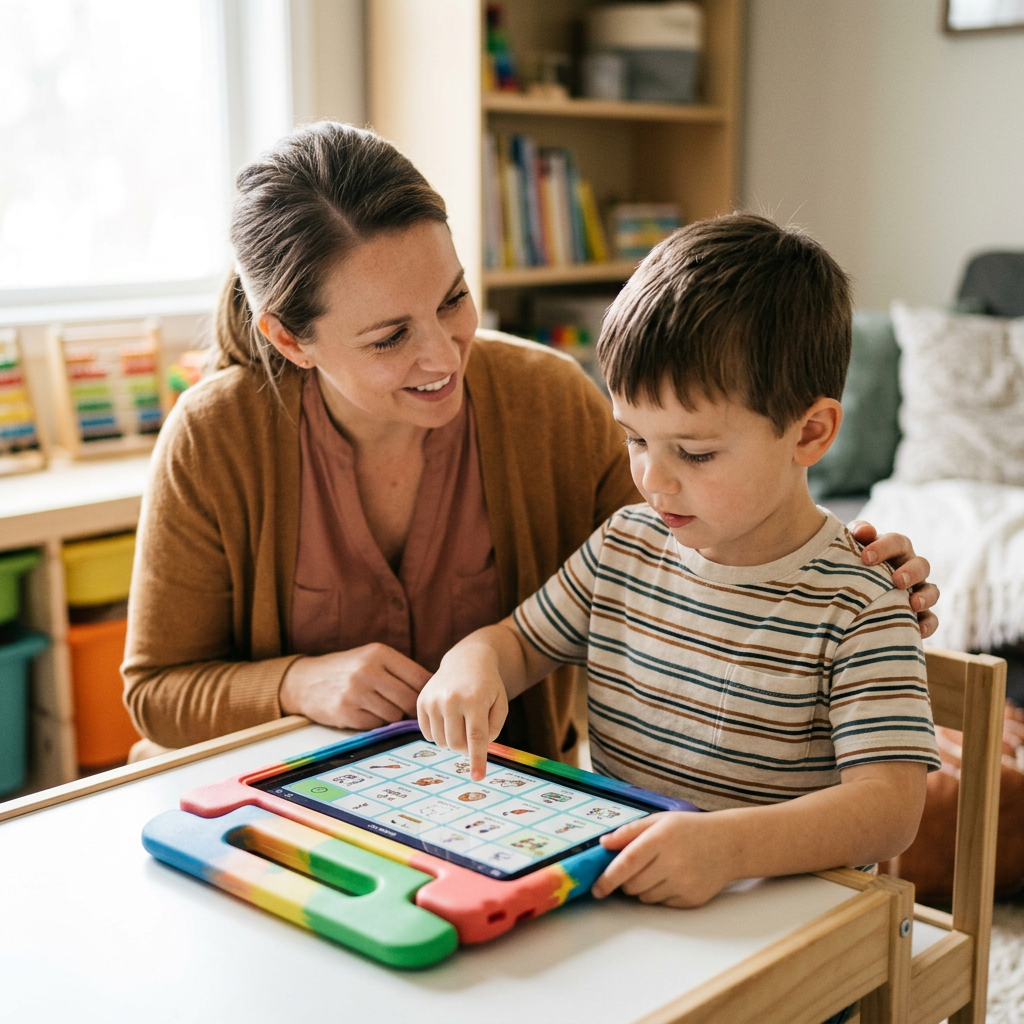
Building Communication Skills in Nonverbal Children

Communication Is Not the Same as Speech
One of the most important things to understand about nonverbal children is this: communication and speech are not the same thing. Speech is one channel of communication. A child can learn to communicate powerfully and meaningfully without ever using spoken words.
For parents of children who are minimally verbal or nonverbal, shifting this mindset — from "my child needs to talk" to "my child needs to communicate" — opens up a world of possibility.
Why Some Children Are Nonverbal
Children may be nonverbal or minimally verbal for a range of reasons, including:
- Autism spectrum disorder
- Childhood apraxia of speech
- Intellectual disability
- Language processing disorders
- Neurological conditions
The cause affects the approach, but the goal is the same: building a reliable, functional system for communicating wants, needs, thoughts, and feelings.
Augmentative and Alternative Communication (AAC)
AAC refers to all the ways people communicate besides speech. It encompasses:
- Picture exchange systems (PECS): The child hands over a picture to request an item or activity
- Communication boards: Visual displays of symbols the child can point to
- Speech-generating devices (SGDs): Electronic devices that produce synthesized speech
- Sign language: Manual signs used to communicate
A common fear among parents is that using AAC will prevent the child from developing speech. Research does not support this. In fact, AAC often supports the development of speech by reducing frustration and increasing communicative success.
Evidence-Based Strategies
1. Respond to All Communication Attempts
Before formal AAC is introduced, recognize and respond to whatever the child is already doing: reaching, pointing, vocalizing, guiding your hand. These are proto-communicative behaviors. Responding to them teaches the child that their attempts work.
2. Model, Model, Model
You can't teach language by waiting for it to happen. Use the AAC system yourself throughout the day. Point to pictures, sign as you speak, use the device. Children learn communication by seeing it in use.
3. Create Opportunities
Set up the environment to make communication necessary and rewarding:
- Place preferred items just out of reach
- Pause during enjoyable routines to create anticipation
- Give a small amount of a preferred food to prompt requests
4. Use Naturalistic Teaching
Communication is best learned in context. Practice requesting during snack, commenting during play, protesting during clean-up. Real contexts make skills meaningful and more likely to generalize.
5. Follow the Child's Lead
Motivation is everything. Build communication around what the child cares about. If they love trains, use trains as the context for teaching communication.
The Role of Behavior Analysis in Communication
BCBAs and behavior technicians are frequently involved in AAC implementation. They conduct preference assessments to identify motivating items, collect data on communication attempts and successes, and adjust strategies based on what's working.
Collaboration between a BCBA and a speech-language pathologist (SLP) produces the strongest outcomes.
A Message for Families
The road to communication can be long and non-linear. There will be moments of extraordinary progress and moments of discouragement. Throughout it all, remember: your child is trying to connect with you. Your job — and ours — is to make that connection possible.
Have questions about your child?
Book a free consultation with Bahij — no commitment, no jargon.
Schedule a Free Call